K-Shaped Education: Are Our Schools Mirroring K-Shaped Economics?
The concept of a "K-shaped recovery" describes a post-recession economy where different sectors and groups experience vastly different fortunes. Some surge upward, while others plummet or stagnate. Not unlike the current NZ economy!
It's a worrying trend, and increasingly, we see this phenomenon being mirrored within our schools, creating a widening gulf between our most successful and most vulnerable learners.
This is not a reflection of teacher effort. It's a reflection of the complete system, including how we manage resources, support pedagogy, and deploy technology within our schools.
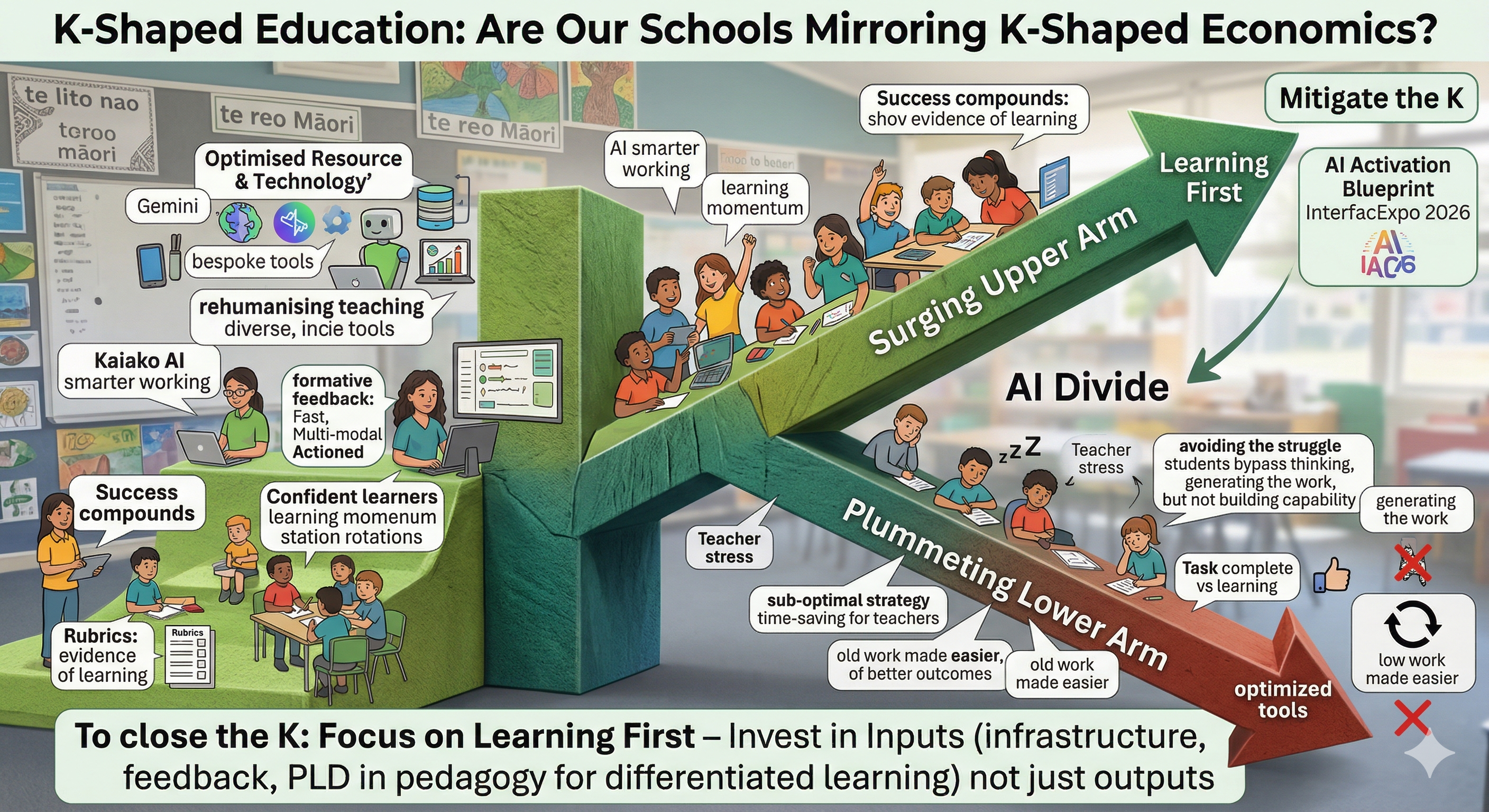
The K-Shaped Classroom Divide
In the educational landscape, the two "arms" of the K are diverging due to three critical factors:
1. Resource and Technology Optimisation (The Strategy Gap)
The upper arm of the K benefits from well-thought-out strategies that rehumanise teaching and learning. In these schools:
Tools are deployed thoughtfully: Schools have activated and optimised tools like Gemini and ensure staff are trained to use them creatively, consistently and effectively to meet the needs of all learners.
The system is bespoke: The infrastructure is managed to ensure high-achieving students are constantly extended and struggling students receive bespoke learning experiences and scaffolding, which is differentiated by age and stage.
The lower arm is constrained by a sub-optimal or absent strategy around how and when certain tools should be used. In these schools:
Time-saving for teachers is prioritised over better student outcomes.
Instead of making the new work better, the new tools just make the old work easier.
2. The Feedback Loop (The Pedagogy Gap)
Success compounds in the classroom:
Upper Arm: Confident, capable students are more likely to act on Formative Feedback that is Fast, Multi-modal, and Actioned. This positive cycle reinforces their self-belief and accelerates learning momentum (the Matthew Effect).
Lower Arm: Students who are disengaged or less confident often struggle to act on feedback, leading to a focus on mere "Task completion vs learning." This perpetuates a cycle of low effort and low-level task completion, instead of effective learning.
3. Smarter working Teachers and harder working Students (The AI Divide Gap)
This is the newest, sharpest edge of the K-shape:
Upper arm: Teachers working smarter. Educators are using AI to create better resources, scaffold content and save time (working smarter). This results in reduced teacher stress and a better learning environment.
Lower arm: Students avoiding the struggle: If AI tools are not carefully
controlled and deployed, students can use them to bypass the necessary struggle of learning and thinking. This risks producing the work rather than the person, robbing students of the capability-building required for future success.
How Do We Close the K-Gap?
We can mitigate this K-shaped divide by focusing on Learning First, investing in the 'inputs' that genuinely drive student success, not just the easily counted 'outputs'. We will soon be launching our AI Activation Blueprint at InterfacExpo 2026, which includes the following:
Optimisation of your foundation: Get your infrastructure, AI tools and security fully optimised for free, freeing up time for pedagogy.
A Focus on Formative Feedback: Implement systems where feedback is fast, actionable, and based on student-friendly rubrics that reward evidence of genuine learning.
Prioritise PLD: Give kaiako the strategies and tools to effectively differentiate and scaffold (e.g., Station Rotations), turning AI into an "Intelligent Assistant" to better accommodate classroom diversity.
Are you seeing this K-shaped phenomenon in your school? Let’s shift the focus back to Learning First to ensure all our ākonga are on the upward trajectory.