Writing is Thinking: Mastering the New 'Communication' Capability
“Writing is thinking. To write well is to think clearly.
That's why it's so hard”
David McCullough
Writing is thinking!
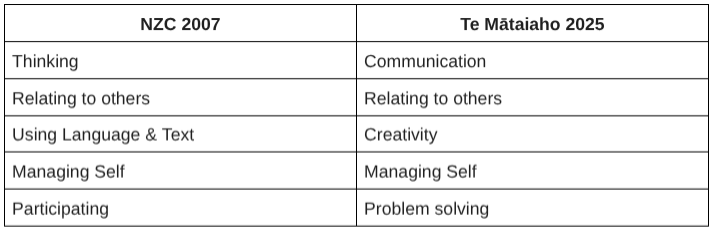
Our recent/ongoing Curriculum refresh has modified our 5 Key Competencies to 5 Capabilities. While “Managing Self” and “Relating to others” remain unchanged, “Thinking” has been replaced by “Communication”.
I actually welcome this - I’d argue that while thinking was possibly the most important Key Competency, it was also the hardest to notice, measure or assess. We’ve all seen students who have developed a conditioned response of squinting their eyes (to give the impression they were thinking) and then just making another, uninformed guess. Sometimes students confuse Thinking with Remembering - it’s quite possible to remember something without understanding it or having learnt it.
In this article, I’ll be focusing on this Communication capability - and how it can be developed through achieving quick and significant improvements in students’ writing.
Much of my work with schools is around coaching Teachers to develop tasks and resources to significantly boost the writing outcomes for students. This process involves 4 key components. These 4 interconnected strategies, implemented together, honour each student's Zone of Proximal Development, effectively manage cognitive load, and accelerate performance and confidence, leading to significantly improved student outcomes:
Differentiated and Scaffolded Tasks: Ensure all tasks are well-scaffolded and differentiated to precisely meet the distinct needs of the three capability groups.
Capability-Based Station Rotations: Divide the class into three groups based on capability. These groups rotate through three stations: direct teaching from the educator, a high-level task guided by a rubric, and a self-directed learning task.
Digital Drafting to Prioritise Handwriting: Students first draft their writing digitally. This workflow ensures that formative feedback is easily and repeatedly acted upon. The final, 'publishing' step is handwriting the revised work on paper. This reversal of the typical classroom process allows the student to focus exclusively on their handwriting during the final stage. Knowing the content is polished through multiple feedback cycles, students take pride in their work's substance, which encourages them to take equal pride in its aesthetic presentation (handwriting).
Iterative Feedback with Student-Friendly Rubrics: Utilise student-friendly rubrics, featuring numerical components, to strongly encourage and track students' multiple, rapid responses to formative feedback.
Here are some comments from students whose writing improved markedly within just a few weeks when using this process.
“We now use the computer actually for drafting cos we can erase it and write it up again which takes less time on computer. When we’ve done our best we then hand write it and it looks great”
“I like how my teacher gives feedback. She changed it so that we have a rubric that's like you need to get points for this grammar, then vocab, then verbs and then we get instant feedback”
“We all prefer to get feedback along the way and not just at the end cos it gives us time to think about it and fix it. When we used to get feedback at the end of our work, we didn’t care. When our teachers used to just speak to us with feedback, we couldn’t remember it all and also didn’t always care. This is way better”
Te Mātaiaho refers specifically to this type of formative feedback:
“Formative assessment is essential to explicit teaching because it helps teachers check what students understand at each step of the learning process. It allows them to adjust their instruction in real time by clarifying, modelling, or reteaching, so that every student can confidently move forward with new learning”