
Teaching vs Learning
_
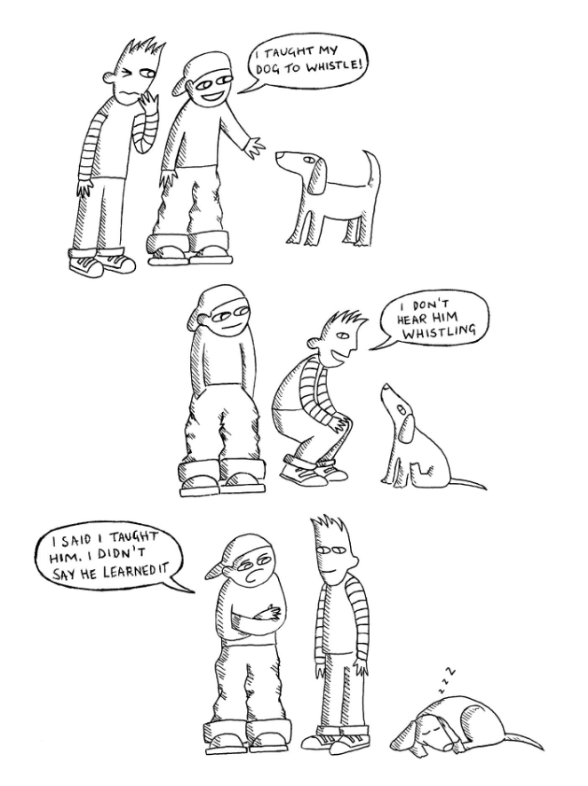
“Just because Teaching has happened
doesn't mean that Learning has happened”
How many times have we been in a staffroom when a teacher is expressing frustration about how challenged their students are at following verbal instructions? (Interestingly, this same level of confusion can be witnessed during PLD sessions or staff hui!!). The issue is (hopefully) not with the laziness or indifference of the recipients of the verbal information. The issue is biology - it is all about the teacher, the messaging, the scaffolding, and the differentiation that makes the information more meaningful, memorable and motivating to the audience.
It is, of course, highly frustrating for any teacher to be regularly repeating themselves multiple times, and I do think it is important that we look at the cognitive capacity of our students to process, retain and act on verbal instructions.
I have yet to work in a New Zealand school in which the teachers do not acknowledge and agree that the typical spread in cognitive capacity in any classroom is between 3 and 5 years. To counteract these significant variations in developmental capacity amongst our students, we need to differentiate and scaffold really well.
In the absence of this, we may tend to backfill with lots of teacher talk to address student confusion or uncertainty about learning. Mixed messages from the Ministry. Curriculum documentation and the Minister have inadvertently encouraged some teachers to talk more during a lesson rather than less. This, of course, is in complete contradiction to many of the great ideas that are expressed in the Science of Learning, particularly with regard to avoiding cognitive overload amongst our students.
To be blunt, a well-designed learning experience (that involves writing) should enable and encourage ALL students to complete that task on their own, rather than incrementally asking for ongoing support and hints around how to complete the task. Honouring the zone of proximal development of every child is possible if we are using smart tools in smart ways.
We assess students relentlessly on reading, writing, and maths, but never on listening skills and learning skills, which I would argue are way more important.
Here's a brief (AI-generated) summary of how a typical 9-year-old student can retain and act on verbal instructions:
For a typical 9-year-old student, cognitive research shows they can retain and mentally process roughly 3 to 4 units (or "chunks") of verbal information at one time. Without immediate practice, active rehearsal, or visual support, this information fades from short-term memory within 20 to 30 seconds.
Here is how cognitive developmental data breaks down what a 9-year-old can reliably retain:
1. Chunk Capacity (3–4 Items)
While adults typically have a verbal working memory capacity of 4 to 7 units, a 9-year-old's brain is still developing. A "chunk" can be a single word, a digit, or a familiar combined concept. If a teacher delivers a string of completely unfamiliar information, the child's brain treats every individual word as a single chunk, which rapidly leads to cognitive overload.
2. Multi-Step Instructional Limits (2–3 Steps)
Speech-language and pediatric norms indicate that school-aged students reliably retain only 2 to 3 distinct instructional steps in a dynamic classroom environment.
When multi-step directions require children to juggle complex rules or switch tasks, their working memory fills up instantly:
Manageable (3 familiar chunks): eg "Open your green notebook, turn to page 12, and write the date."
Overload (5+ chunks): eg "Grab your history binder, find the worksheet from yesterday, copy down the paragraph on the board, and when you're finished, put it in the red bin and read silently." (By step three, the final instructions are usually forgotten.)
3. Sentence Length Retention (Up to 12 Words)
Developmental milestones show that a typical 9-year-old can read, track, and fully process the immediate context of sentences up to 12 words long. Beyond this length, the beginning of a spoken sentence often begins to drop out of their phonological loop (the verbal storage component of memory) before the speaker finishes talking.
Factors That Impact These Numbers
The Variance Gap: Working memory capacity varies drastically from student to student. In a single classroom of 8- to 9-year-olds, a few students will have the memory capacity of an average 5-year-old (1–2 units), while others will match a 13-year-old (4–5 units).
The "Forgetting Curve": Once information leaves temporary working memory, standard learning drop-offs apply. Humans generally forget up to 50% of spoken information within one hour unless they immediately apply it or teach it to someone else.
Environmental Noise: Auditory clutter, stress, digital distraction and classroom anxiety severely diminish these numbers, causing kids to "zone out" when cognitive limits are breached.
It’s beyond obvious that when students are regularly exposed to excessive and instantly forgettable verbal content from their teacher, they may well learn to just zone out and hope for the best.