
The Matthew Effect in Education: How the (educationally) Rich Get Richer, and the Poor Get Poorer
The concept of the Matthew Effect is a powerful, yet sobering, observation about success and resources, which is perhaps most poignantly visible in education. Drawing its name from a passage in the Gospel of Matthew ("For to every one who has will more be given, and he will have abundance; but from him who has not, even what he has will be taken away"), the term describes a cumulative advantage, or disadvantage, over time.
In the context of schooling and learning, this means that initial, small differences in skill or resource can snowball into significant, enduring disparities.
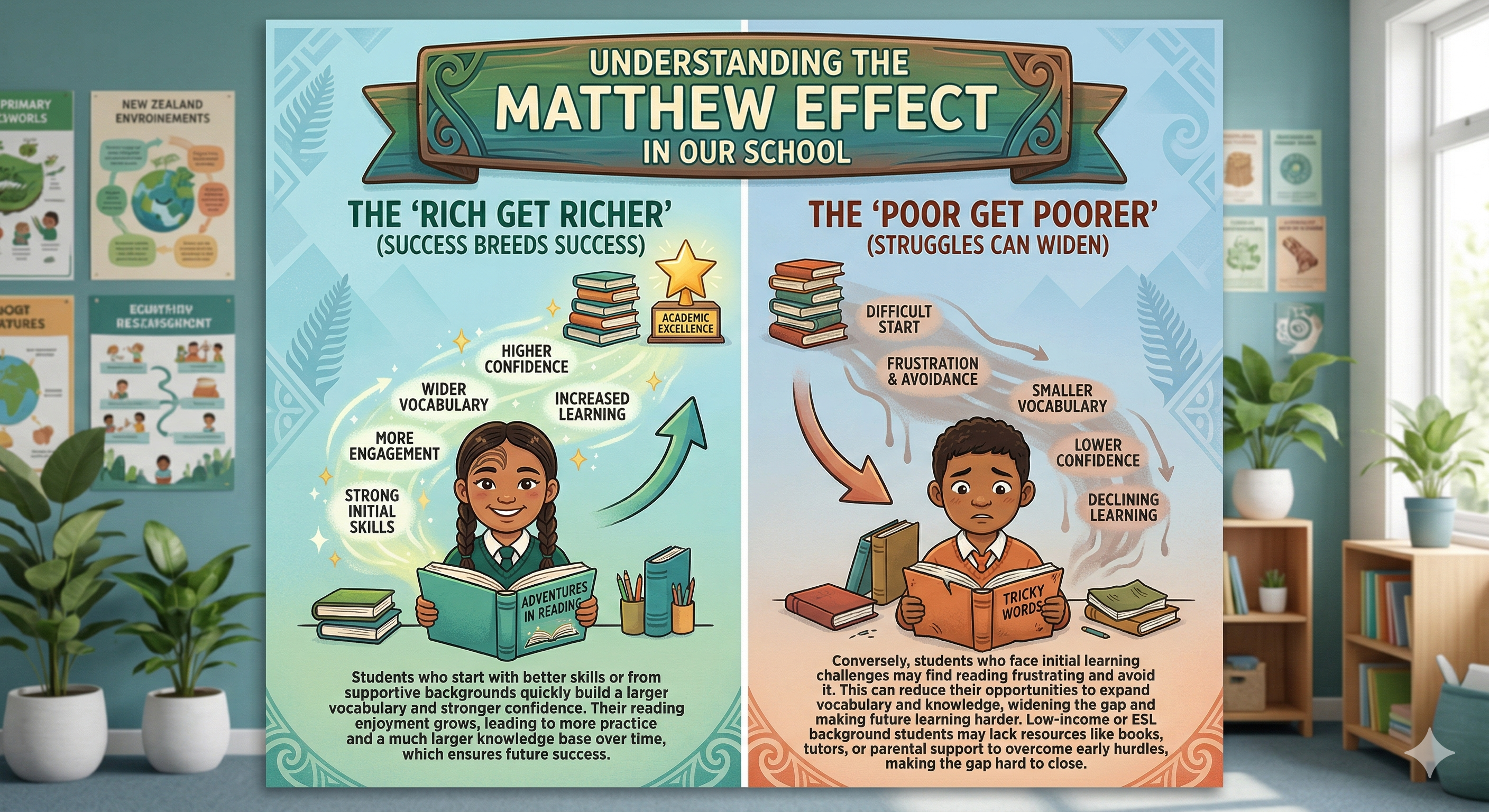
How can we address the Matthew Effect in the Classroom?
Here are a few examples of how it can play out:
Access to Quality Resources: If a school has fully deployed and optimised tools, as per our soon-to-be-released AI Activation Blueprint, its teachers can rapidly create highly scaffolded, differentiated, and engaging learning experiences. This allows high-performing students to be further extended and for struggling students to receive bespoke support, accelerating all learners. In a school with sub-optimal AI deployment, teachers may well use the new tools, but in ways that don’t effectively prioritise the diverse needs of our learners, and further compound bell curve issues of capability.
Formative Feedback - Nothing succeeds like success: When most formative feedback in a classroom is verbal, the student who attracts the most feedback may also be the least cognitively capable of remembering it and acting on it. This issue is also addressed in our soon-to-be-released AI Activation Blueprint, which gives teachers pedagogical and technical tools to ensure that formative feedback is "Fast, Multi-modal and Actioned", and triggered by well-designed rubrics.
Breaking the Cycle: Strategies for Equity
The great challenge for educators is to intentionally interrupt this cycle of cumulative advantage and disadvantage. If the system defaults to giving more to those who already have more, we must intentionally design our practice to address this effectively.
Here are strategies to counteract the Matthew Effect:
Differentiated and Scaffolded Tasks: As championed in our recent blogpost article, "Search and Rescue", teachers must move away from the "one size fits nobody" model. Tasks must be intentionally designed with multiple, smooth on-ramps to learning (as explored in "Multiple smooth on-ramps to learning").
Targeted AI-Assisted Support: Teachers can leverage Intelligent Assistance (IA), as opposed to Artificial Intelligence (AI), to free up time for small-group instruction and targeted interventions. Tools like Gemini for Education can dramatically accelerate the creation of bespoke learning materials, ensuring that struggling students are supported within their Zone of Proximal Development.
Emphasise Effort and Capability Over Output: Use rubrics that explicitly reward effort, responsiveness to feedback, and the development of learning habits alongside task completion. This shifts the focus from "producing the work" to "producing the person," a critical distinction raised in "Work smarter, not harder - or vice versa?".
The Matthew Effect is a powerful force of nature in education. By understanding its mechanics, we can design instructional and resourcing strategies that break its grip in the classroom, ensuring that initial challenges do not become lifelong barriers.
The goal is not to slow down the strong learners, but to use effective, intentional pedagogy, accelerated by smart tools, to lift outcomes for everyone.