The Whole is Greater than the Sum of its Parts
.
Recently, I was invited to contribute to a Google webinar for teachers in New Zealand and Australia; the theme was "Accessibility and Inclusion for all". A few people suggested to me that I should share the recording, so here it is. It touches on the following areas:
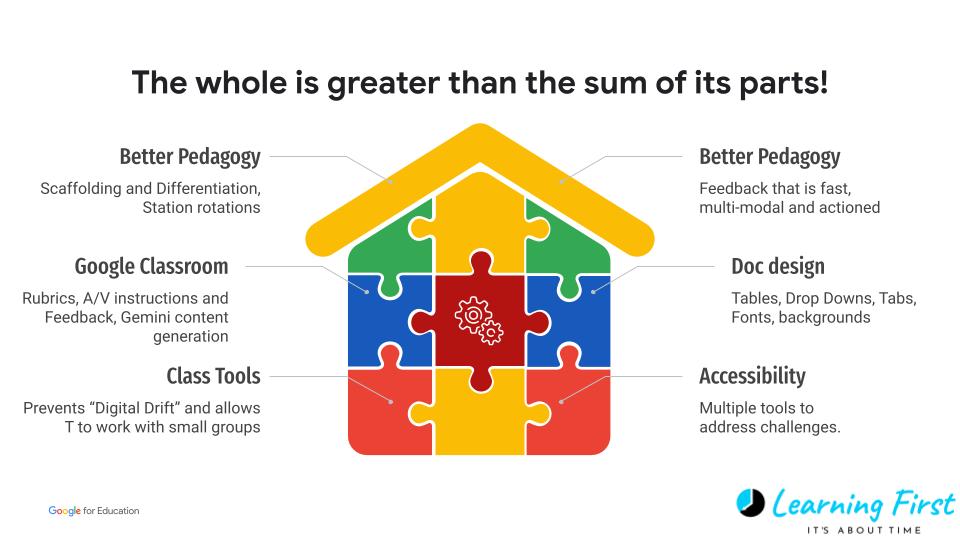
Lowering screen time and raising expectations, especially in the area of writing.
Designing learning experiences so that all students complete the tasks fully and on their own, in less time.
Using student-friendly rubrics that ensure that feedback is fast, multimodal, and acted on by all students.
Lowering cognitive overload by design.
Spending less money on platforms and more on people.
The effective use of digital tools to meet the learning needs of all students. To include “fitting” them in similar ways they would be fitted for visual or hearing aids.
Some ideas about what to do differently from day 1 of 2027 - leaving poor habits behind.
Training SENCO, Learning Support staff and students to make the best use of these tools and strategies.
Using Google Class Tools <LINK TO ARTICLE IN ISSUE 9 ON THIS> to minimise digital drift and to maximise student accountability and performance.
Designing for "Station Rotations" that boost student/teacher relationships, accountability, and work completion.
Removing devices for some or all of Term 1 and teaching our students how to think, learn, question, act on and give feedback etc.
Do feel free to forward this to the relevant staff and let me know if you'd like to discuss any of these ideas for your school, as you plan for 2027.