We Aren't Crazy, We're Just Early: Avoiding the Unwise Use of AI in Schools

In the world of technology adoption, there’s a phrase often used by those on the cutting edge: "We aren’t crazy, we’re just early."
This sentiment perfectly captures the current moment with Artificial Intelligence in education. The rapid deployment of AI tools, like the default activation of Gemini and NotebookLM for all ākonga, can make those who advocate for caution feel like they are standing in the way of progress.
Yet, our concerns are not about resisting innovation; they are about protecting the very foundations of learning. Our apprehension is not ‘crazy’, it is a measured, professional response to an untested shift. We are simply being early in recognising the potential pitfalls of unwise implementation.
The Pitfall of Low-Hanging Fruit
AI offers undeniable low-hanging fruit: tools that easily and quickly reduce both teacher workload and student cognitive load.
For teachers, this can look like effortless content creation. For students, it can look like bypassing the necessary struggle of learning.
As we argued in "Work Smarter, Not Harder Or Vice Versa?", the agenda for AI use can be disappointingly similar for both groups:
Teachers should be working smarter (using AI) to create better scaffolds and reduce stress.
Students should be working harder (using their brains), not smarter (using AI).
The moment a student uses AI to generate content (to support a task) without engaging in the intellectual work of recall, debate, ponder, and analysis, the purpose of the task, which is to produce a certain kind of person, is lost.
The Risk of Bypassing the Struggle
This brings us to our most critical concern: the unintentional erosion of fundamental learning behaviours.
All technology acts as an amplifier/accelerant of what we are already doing. If what we are doing is prioritising task completion over genuine learning, AI will simply accelerate this negative trend.
Here’s where the wise use of AI differs from the unwise:
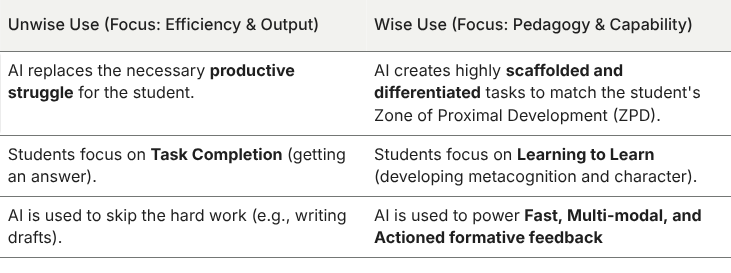
The challenge of an effective teacher, as mentioned in "Task completion vs learning", is creating multiple, smooth on-ramps to learning. AI should be the machine that builds those differentiated on-ramps, not the vehicle that drives the student past the construction site entirely.
What We Are Advocating For
The "early" perspective is one of intentionality and control. We are not crazy for asking schools to:
Disable AI Tools for Ākonga: Until a clear, school-wide strategy on enhanced pedagogy, academic integrity and skill development is in place, we advise schools to manage these settings carefully, with a nuanced approach to age and stage of all ākonga.
PLD for kaiako: Educators need PLD to move from AI literacy to AI agency. The 80/20 model, when AI does about 80% of the preparation work, and the kaiako does the remaining, critical 20%, ensuring human pedagogical expertise remains the critical driver.
Prioritise Pedagogy First: The most significant outcomes from learning are the character traits developed within the learner. We need to focus on inputs like pedagogy and responsive resource creation, not just easily quantifiable outputs.
We aren't Luddites; we are educators committed to deep, meaningful learning. We are simply urging some caution, ensuring that the new technologies are used to amplify human capability, rather than replace or diminish it.
If you feel you would like help with developing AI literacy, please feel free to contact us at Learning First. We would be happy to share our AI Activation Blueprint so that all learners at your school, whether young or not so young, can thrive.